Drone and Aerial, Selling the Seclusion Guests Can't See Inside
By Zach Johnston · August 18, 2026 · 8 min read
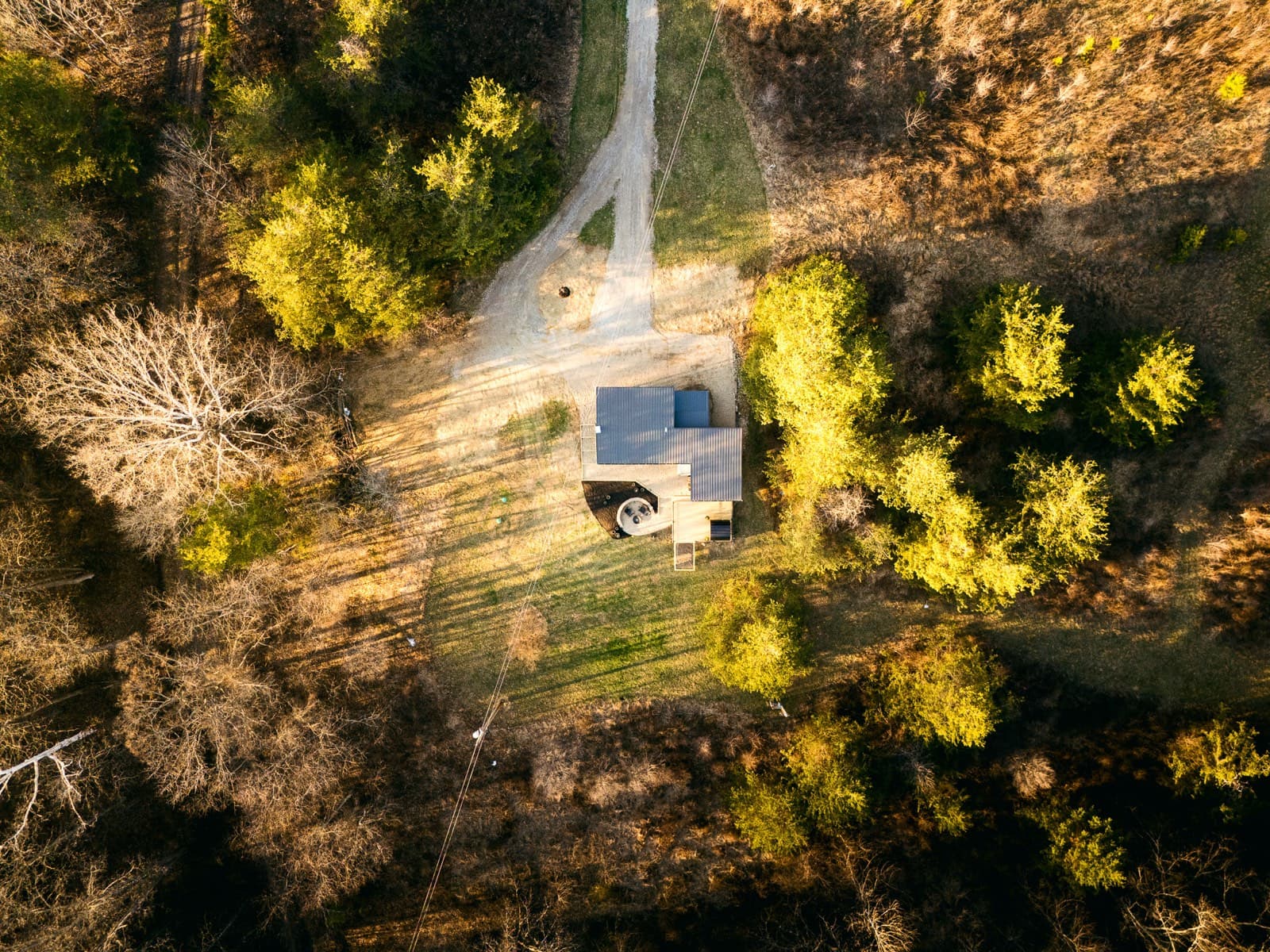
The thing a Hocking Hills guest is really buying is seclusion, and that is exactly what your interior photos cannot show. An aerial answers the question every guest is asking: how tucked into the woods is this place, and how far are the neighbors? A few good aerials do that better than any interior shot can.
The short version:
- Guests here book privacy and setting. Interiors show the rooms; only an aerial shows the woods around them.
- Aerials do context best: tree cover, acreage, the ridge or hollow, distance to the nearest roof.
- Never lead a listing with a far-off aerial where the cabin is a tiny dot. That is a supporting frame, not the hero shot.
- Two to five aerials in a gallery is a healthy range. Past that they start repeating the same canopy.
- This is the local edge a national competitor cannot copy: your specific patch of Hocking County woods.
What does an aerial show that interior photos can't?
It shows the setting. A wide-angle living room tells a guest what the couch looks like; it says nothing about whether the next cabin is fifty feet away or half a mile through the trees. The aerial is the only frame in your gallery that answers the privacy question directly.
That matters because privacy is the product here. Guests come to Hocking Hills to get away from neighbors, and the drive market runs deep. A Spectrum News report on Hocking Hills tourism put regional visitation at up to about five million people a year, most of them driving in from Columbus, Cleveland, Cincinnati, and Pittsburgh. Nearly all of them are trading a city block for a wooded hollow, and they want to see the woods before they book.
Interior photos are interchangeable. A soaring great room in your cabin looks a lot like a soaring great room three counties over. The land around your cabin does not, and the aerial is how you sell the difference.
It also settles a worry guests carry into every booking. People reading a listing are quietly asking whether the photos are hiding something: a highway just past the treeline, a cluster of other cabins packed in tight, a lot smaller than it looks. An honest aerial answers that before they have to ask, and honesty on that point earns the click as much as beauty does.
Why does seclusion sell so well in this market?
Because it is the reason people pick Hocking Hills over a hotel or a lake house closer to home. The region competes on quiet and trees, so a listing that proves both starts ahead. An aerial is the fastest proof there is.
Presentation quality carries real weight in how much a property gets seen. A 2016 Carnegie Mellon study of more than 7,000 Airbnb listings found that verified professional photos drove about 17.5 percent more demand and roughly $2,521 in added revenue per year. That study covers listings in general rather than aerials specifically, so treat it as directional, but the mechanism is the same: better photography pulls more eyes to the listing, and attention is what a booking starts with.
The platforms reward that pull, too. Airbnb's own ranking help page lists listing quality, including photos and videos, among the factors that influence where a listing lands in search. An aerial that shows your setting well is quality the algorithm can see and guests can feel.
What do drone photos do well, and poorly?
Aerials are a specialist tool. They are unbeatable at a few jobs and clumsy at everything else, so it helps to be honest about both columns before you plan a shoot.
| Aerials do this well | Aerials do this poorly |
|---|---|
| Show tree cover and how tucked-in the cabin sits | Show interior spaces or amenities |
| Prove acreage and distance to neighbors | Carry a listing as the cover photo |
| Establish ridge, valley, or hollow context | Read at thumbnail size when the cabin is small in frame |
| Show proximity to a creek, pond, or trailhead | Flatter a cabin on a plain gravel lot with no trees |
| Give a sense of the whole property in one frame | Replace ground-level twilight and detail shots |
The single most common mistake I see is a listing led by a far-off aerial where the cabin is a speck in a green blanket. It looks impressive on the photographer's screen and tells a guest nothing. The cover photo has one job, to say what the place is in half a second, and a tiny dot cannot do it.
Where aerials shine is the medium altitude, close enough that the roofline and deck read clearly, high enough that you can see the treeline wrapping the property. That is the frame that says private without saying speck.
Season and light change what an aerial is worth, too. Bare winter branches expose every neighboring roof and the road, so a leaf-off aerial can undersell a property that feels tucked away from May through October. Green-season and fall passes hide those sight lines the same way the trees do in person, and the low angle of morning or late-afternoon light gives the canopy depth instead of a flat green sheet. An aerial shot at noon in November is technically the same property and a much weaker sell.
Does the pilot's certification matter?
For a commercial shoot, yes. As of this writing, any photographer flying for hire has to hold an FAA Part 107 certificate, the commercial drone rule the Federal Aviation Administration requires for paid work. Drone rules change, so it is worth confirming the current requirement. It is a real exam covering airspace, weather, and flight rules, not a formality.
For you as an owner, the certificate is a trust signal. It means the person over your property knows the airspace they are flying in and is certified to operate legally, which protects you as much as them. If a photographer offers aerials without mentioning it, that is a fair question to ask before you book.
Certification does not make a photo good; composition and light do that. But it is the floor, and any working aerial shooter clears it as a matter of course.
How do aerials fit into a gallery?
Early, and usually more than one. An aerial works as an establishing frame, the wide shot that sets the scene before the gallery moves indoors. Place your strongest one in the opening sequence, right after the ground-level exterior, so a guest gets the setting before the rooms.
Here is the order I plan for most cabins:
- Cover photo: the strongest ground-level exterior or twilight frame, the one that reads at thumbnail size.
- The aerial: one medium-altitude shot that shows the woods wrapping the property.
- More aerials, as they earn it: two to five is a healthy range, each adding something new, like a creek, a ridge, or the fall canopy the first frame missed.
- Interiors and details: the great room, the kitchen, the hot tub, the bedrooms.
Two to five aerials covers most properties. Past that they start repeating the same green canopy, and gallery space is better spent on the deck, the view from the windows, and the amenities that close the booking. Aerials set the stage; the ground-level professional photos do the selling.
Timing helps, too. An aerial shot during peak fall color shows the property at its most sought-after, and a short aerial pass makes a strong opening for a video tour if you add motion later. If you are planning a shoot, my free staging checklist covers getting the grounds camera-ready, trash bins hidden, cars moved, deck cleared, before anyone flies.
Aerial photo FAQ
Should my cover photo be an aerial?
Almost never. The cover has to read at thumbnail size, and a cabin small in a wide aerial disappears at that scale. Lead with a ground-level exterior or a twilight frame, and let the aerial do its work a few slots into the gallery where a guest is already looking closely.
How many aerials does a listing actually need?
Two to five for most properties. One strong establishing frame is the minimum, and additional aerials earn their place when they show something new: a creek, a ridgeline, the fall color, a different edge of the acreage. Past about five they start to repeat the same canopy, so that is where I stop.
Do I need a licensed drone pilot?
If you are hiring the work done, the photographer needs an FAA Part 107 certificate to fly for pay, so yes. It is worth confirming before you book. It protects you legally and tells you the person over your roof understands the airspace.
Will an aerial help if my cabin has no trees around it?
Less so. Aerials sell seclusion and setting, so a cabin on an open gravel lot has less to gain from one and may be better served by ground-level photos that play to its own strengths. The right mix depends on the property, and it is worth weighing before you book any shoot.
Thinking about adding aerials to your listing? Contact me to plan a shoot that puts your setting in the frame. And if you want to see how an aerial sits alongside the ground-level frames in a full gallery, look through the portfolio.
Ready to show your place at its best?
Let's capture your Hocking Hills stay with photo, video, and drone that book the calendar.
Work with me